
Search IPTV Maryland and you get subscription sellers, a stadium job listing, and a code repository full of playlist files. That spread is not a search engine failing. It is an accurate reflection of a term that means four separate things to four separate groups of people in this state, and the first useful thing anyone can tell you is which one you are looking at.
IPTV means television delivered over an internet protocol connection rather than a broadcast signal or a cable channel slot. In Maryland the term covers four distinct things: the technology itself, equipment from an internet company such as Verizon Fios, systems installed in businesses and venues, and subscriptions sold by third parties. Those are not interchangeable.
What IPTV means
IPTV stands for Internet Protocol Television. Strip away the marketing and it describes a delivery method: video reaching a screen as internet data packets, the same way a web page or an email does, rather than as a broadcast signal pulled from the air or a dedicated frequency on a coaxial line.
That is the whole definition. It says nothing about what you are watching, who is sending it, or whether any of it is authorized.
Television delivered over an internet connection
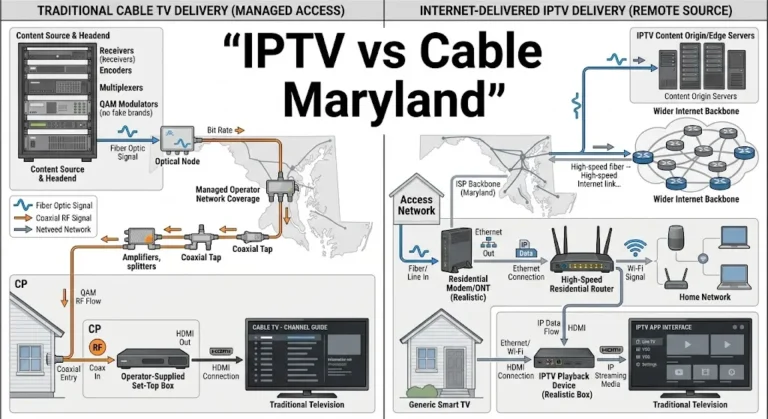
Traditional cable assigns each channel its own slice of the signal coming down the line. Every channel is arriving at your home continuously whether you watch it or not, and the box simply tunes to one.
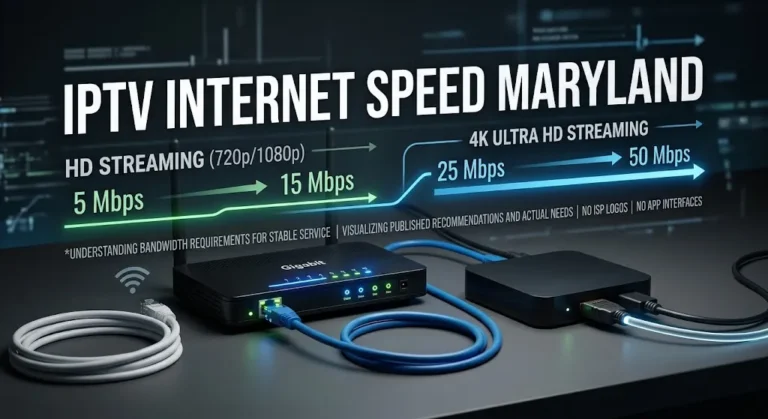
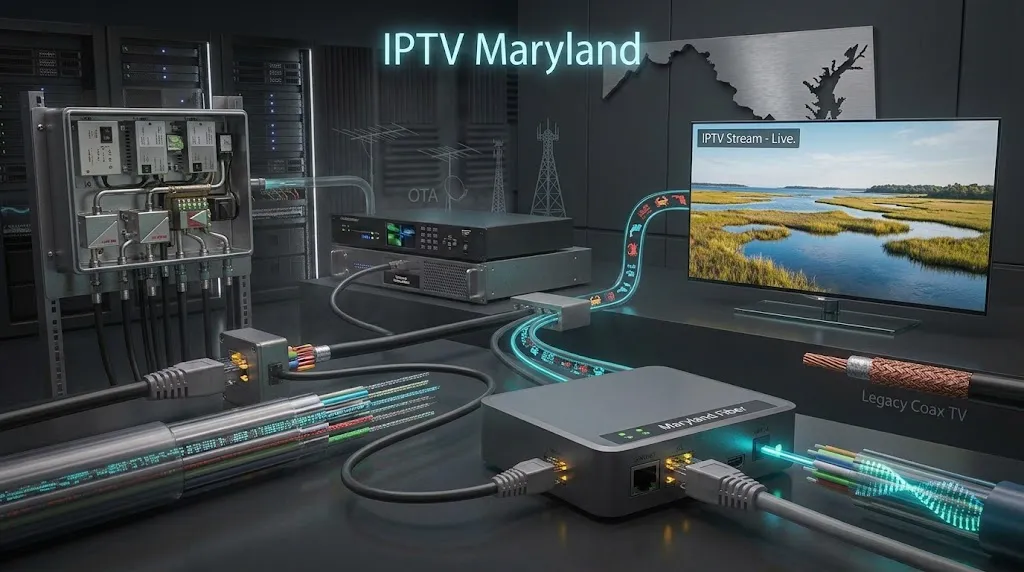
IPTV inverts that. Nothing arrives until something requests it. When you select a channel, your device asks a server for that stream and the server sends it. The practical consequence is that the quality of your connection stops being a background detail and becomes the thing the picture depends on.
Live channels and on-demand content
Two different behaviors travel under the same name. A live channel is continuous — it plays on a schedule you cannot influence, exactly like broadcast television. On-demand content sits in a library and starts when you press play.
Most systems do both, which is why the distinction gets lost. It matters because the two fail differently, and knowing which one is stuttering narrows the cause considerably.
The guide is a separate piece
The on-screen schedule listing what is playing now and next is not part of the video. It comes from a separate file, from a separate address, often from a different organization entirely.
This surprises people. A guide can be blank, wrong, or several hours out of step while every channel plays perfectly, because the two have almost nothing to do with each other. Maryland sits in the Eastern time zone with no county exceptions, which makes a shifted guide here almost always a time-offset problem rather than a broken channel list.
Four different things called IPTV Maryland
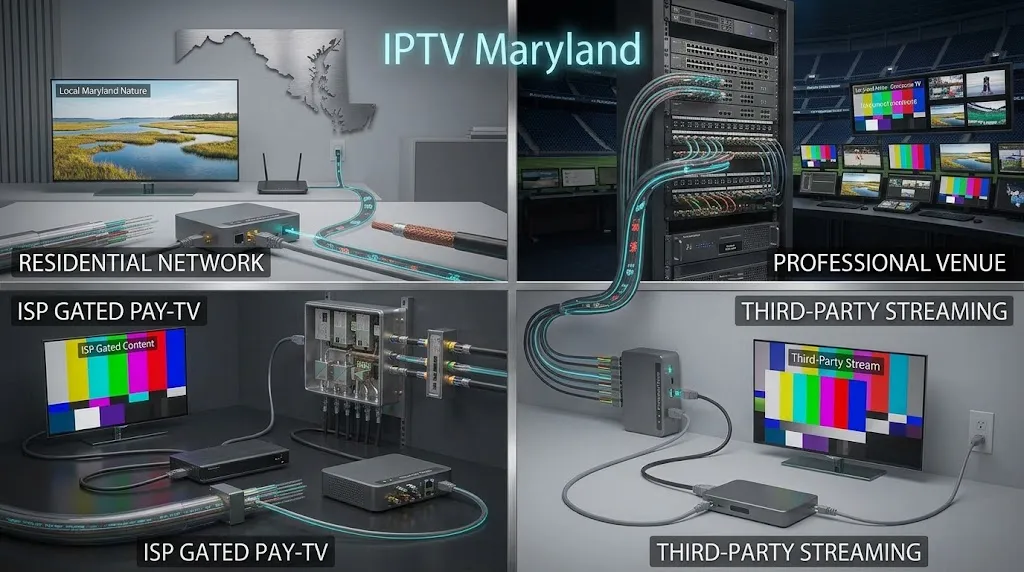
Here is where the search results stop making sense until you split them apart.
The delivery technology itself
Everything described above. A method, not a product. Nobody sells it and nobody owns it — it is how video moves.
Verizon Fios equipment
Verizon states that Fios TV customers can watch their television content on their own streaming hardware through the Fios TV Home app, which it lists as available on Apple TV and Amazon Fire TV devices. That is television arriving over an internet protocol connection from the company that already supplies the line.
So a Fios customer in Maryland who encounters the word IPTV may be reading about their own equipment changing, with no third party involved anywhere. Different situation, same three letters.
Business and venue systems
Large buildings run their own IPTV installations for internal distribution — the Maryland Stadium Authority posts a staff position dedicated to operating IPTV and digital signage systems at the Camden Yards complex. This is infrastructure, not a consumer service, and it never intersects with anything a household would buy.
Third-party subscriptions
The fourth meaning is the one dominating the search results: services sold by companies that are neither your internet company nor a licensed broadcaster.
This site does not name, rank, compare, or recommend any of them, and does not publish prices, channel counts, or performance claims about them. That is a fixed editorial position, explained in full in our DMCA disclaimer and copyright policy. What can be said usefully about this category — how the legal picture works, what warning signs matter — is covered separately in our legal and consumer-safety material.
Why Maryland changes the picture
Two local realities affect how any of this behaves here.
More than one broadcast market
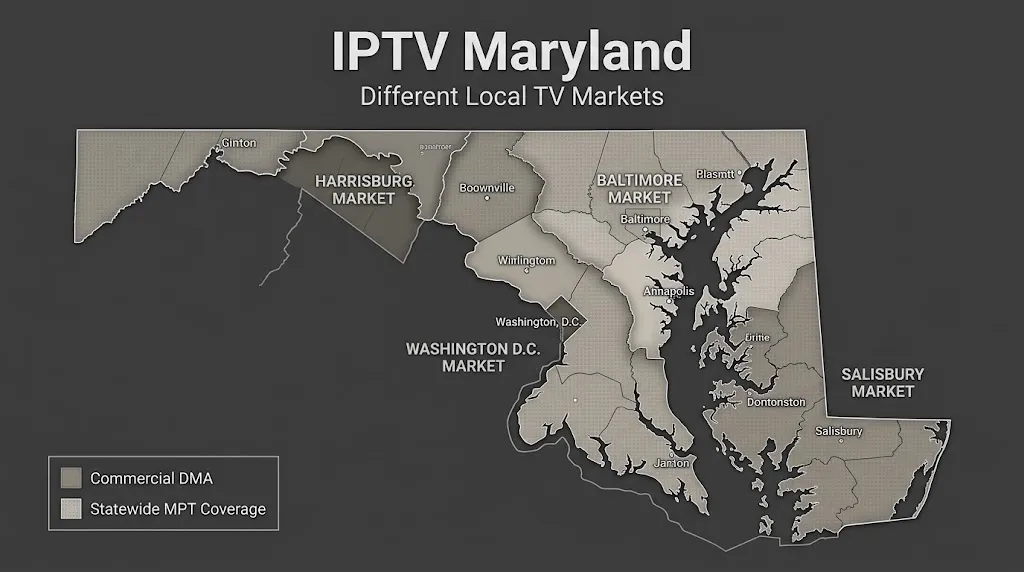
Maryland is not served by a single television market. Stations licensed in the state are spread across several, and households in different parts of the state receive different local channel lineups as a result. Maryland Public Television operates statewide across all of them, but commercial local channels do not work that way.
Anyone reading a guide written for “Maryland” as though it were one market will find the channel information does not match what they actually receive.
Cable and fiber are not the same underneath
The two dominant connection types in Maryland households — Comcast Xfinity on coaxial cable and Verizon Fios on fiber — differ in ways that matter once video depends on the connection rather than running alongside it. Upload capacity, how neighborhood traffic is shared, and how a degrading line announces itself are all different between them.
A stream behaving badly on one is not necessarily diagnosed the same way as the same symptom on the other.
Where to go from here
The term IPTV Maryland stops being confusing once the four meanings are separated. What comes next depends on which one brought you here: understanding the technology in more depth, working out what a home connection needs to carry it, choosing between applications and devices, diagnosing something that has stopped working, understanding the legal position, or finding Maryland’s own local channels. This site covers each of those as its own subject rather than blending them into one page.
Every factual claim here is checked against a primary source before publication and re-checked on a published schedule — how that works is set out in full. If something on this page is wrong, telling us is the fastest way to get it fixed.
Sources
- Verizon — Fios TV Packages — https://www.verizon.com/home/fios-tv/ (accessed September 2026)
- Maryland Stadium Authority — IPTV Specialist — https://mdstad.com/careers/iptv-specialist (accessed September 2026)